This name belongs to countless Saints!
It’s especially popular in Italian and Italian-American culture, including my family.
My first name is a variant of this name.
I was named in honor of two of my great-grandmothers.
Both of these great-grandmothers were named Theresa, and both of their nicknames were Tessie!
They both passed away before I was born, one in 1967 and one in 1985.
One of my dad’s sisters was named Theresa, and her nickname was Teri.
She passed away at age 11 on Oct. 12th 1962, which is why I published this post today.
My Aunt Theresa and I have the same initials. Her middle name was Rosemary and mine is Rose.
I have many more relatives who have this name as their first or middle name.
I dedicate this post to all of my relatives who share this name.
Theresa
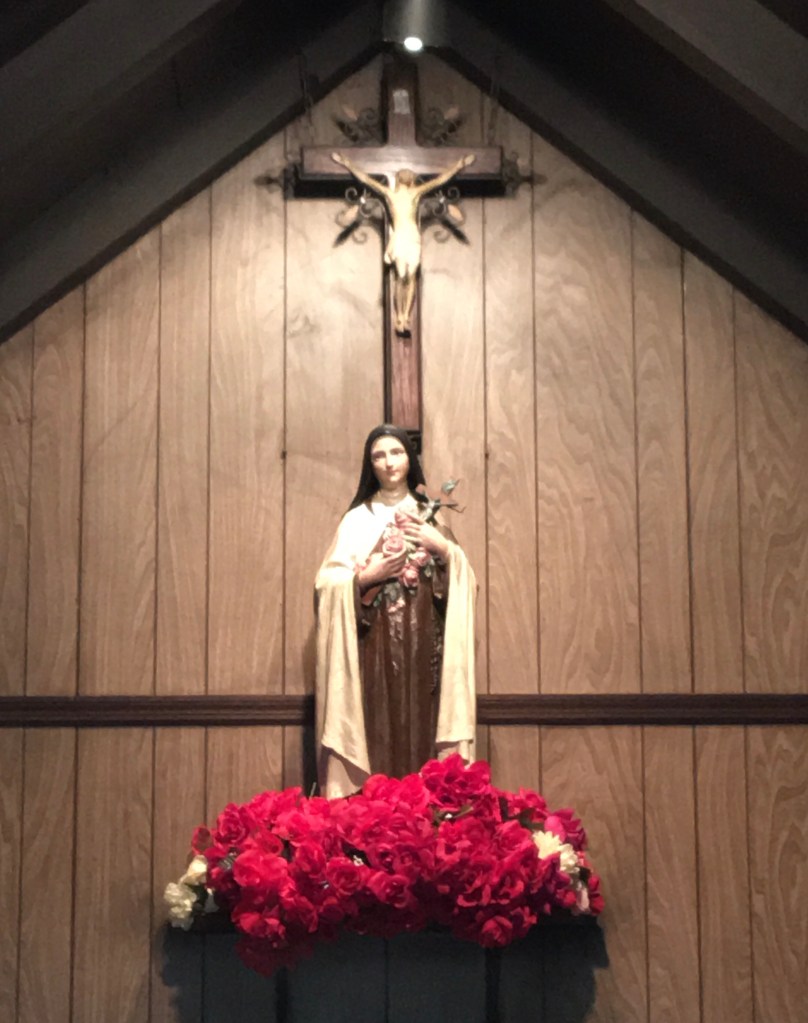
Origin and Meaning
- From the Spanish and Portuguese name Teresa. It was first recorded as Therasia
- The meaning is uncertain, but it could be derived from Greek θέρος (theros) meaning “summer”, from Greek θερίζω (therizo) meaning “to harvest”, or from the name of the Greek island of Therasia (the western island of Santorini)
Spelling Variations
- Theresa – English, German
- Teresa – Catalan, Danish, Finnish, Italian, Lithuanian, Norwegian, Polish, Portuguese, Spanish, Swedish
- Tereza – Bulgarian, Croatian, Czech, Romanian, Serbian, Slovak
- Theresia – Dutch, German
- Terezija – Croatian, Slovene
- Teresia – Swedish
- Terézia – Hungarian, Slovak
- Thresia – Malayalam
- Therese – Danish, English, German, Norwegian, Swedish
- Thérèse – French
- Teréz – Hungarian
- Teresė – Lithuanian
- Terese – Basque, Danish, Norwegian, Swedish
- Terry, Tess, Tessa, Tessan, Tracey, Trees, Teresita, Thea, Thera, Teca, Tena, Tere – diminutives and nicknames in various languages
Information from: behindthename.com
People
- St. Teresa Margherita Redi (1747-1770) is also known as Anna Maria Redi (her baptismal name), Teresa Margaret of the Sacred Heart, and Teresa Margherita of the Sacred Heart. She was born in Arezzo, Tuscany, Italy to the noble parents Count Ignatius Redi and Camilla Billeti. From an early age, she exhibited a strong piety and a deep understanding of God’s love for all people, which she believed was not shared by everyone. At the age of nine, she began her education at the Saint Apollonia convent in Florence, Italy. Despite her young age, she demonstrated remarkable maturity and was often entrusted with the responsibility of watching over her peers. During this time, she developed a fervent desire to receive her First Communion and developed a strong devotion to the Blessed Virgin Mary. She engaged in extensive correspondence with her father, discussing her spiritual experiences and reflections in great detail. However, she requested that her letters be destroyed after being read, and sadly, her father complied with her wish. In September 1763, she received a message from Saint Teresa of Avila advising her to join the Carmelite order. She briefly returned home to Arezzo at the age of 17 but quickly returned to Florence. On 1 September 1764, she entered the Discalced Carmelite convent of Saint Teresa and took the name Teresa Margherita of the Sacred Heart. She received the veil on 11 March 1765 and made her final vows on 12 March 1766. Within the convent, she dedicated herself to serving in the infirmary. It was believed that she possessed a gift of healing, as she demonstrated an ability to predict her own impending death less than five years after taking her final vows. Her short life and vocation were characterized by a deep and contemplative union with God. She constantly meditated on her favorite phrase, “God is love,” and sought to live in accordance with this understanding of divine love. On 7 March 1770, at the age of 22, Sister Teresa Margherita Redi passed away in Florence, Italy due to a severe and painful abdominal disorder. In the weeks following her death, her body underwent a remarkable transformation. Any swelling and discoloration disappeared, her body remained incorrupt, and it exhibited a healthy glow and emitted a pleasant perfume-like fragrance. In recognition of her holiness and the numerous miracles attributed to her intercession, she was beatified by Pope Pius XI on 9 June 1929. Later, on 19 March 1934, Pope Pius XI canonized her as a Saint of the Catholic Church. Although she does not have a specific patronage assigned to her, her life and example continue to inspire and encourage believers to seek God’s love and live in union with Him. Her unwavering faith and dedication to prayer serve as a powerful reminder of the transformative power of God’s love in the lives of His faithful followers. Feast Day: March 7
- St. Mariam Thresia Chiramel Mankidiyan (1876-1926) was born in Trichur, Kerala, India and is from the Syro-Malabar rite. She was baptized with the name Thresia in honor of St. Teresa of Avila. From a young age, she demonstrated a deep piety and desire for a life devoted to God. At the age of 10, she made a private vow of chastity, dedicating herself to a life of purity and holiness. Tragedy struck when her mother passed away when she was just 12 years old. This event deepened her faith and propelled her to commit herself to prayer and serving the poor and sick in her parish. Her compassionate heart extended to the lonely individuals in her community, whom she sought to comfort. In her pursuit of a more meaningful spiritual life, she formed a prayer group with three friends. Together, they engaged in apostolic work, reaching out to the neediest families in the village, including those from the Untouchables caste, who faced societal discrimination. In 1903, she requested permission from Apostolic Vicar Mar John Menachery of Trichur to build a house of prayer and retreat. However, her request was initially refused. Mar John Menachery encouraged her to test her vocation by entering different Congregations. She followed this advice and joined several religious communities. She had a vision from the Blessed Virgin Mary and was instructed to add Mariam to her name. She had many spiritual experiences, which included receiving the stigmata. Eventually, in 1913, her bishop granted her permission to establish the home she envisioned. On 14 May 1914, Mariam founded the Congregation of the Holy Family. Under her guidance, the Congregation flourished, with the establishment of three convents, two day schools, two boarding schools, a study home, and an orphanage. By the time of her death, the Congregation had grown significantly and had expanded its presence to Kerala, northern India, Germany, Italy, and Ghana, with over 170 houses. She lived a life dedicated to God and the service of others. Her selflessness, deep spirituality, and commitment to prayer were evident in her tireless efforts to uplift the marginalized and comfort the lonely. She was known for her compassion and her desire to reach out to the most vulnerable in society, not only through her direct service but also through the establishment of a religious Congregation that would continue her mission even after her passing. Mariam’s extraordinary virtues were recognized by Pope John Paul II on 28 June 1999, when he declared her Venerable. On 9 April 2000, Pope John Paul II beatified her, acknowledging her sanctity and the miracles attributed to her intercession. Finally, on 13 October 2019, Pope Francis canonized her as a Saint in a ceremony held at Saint Peter’s Basilica in Rome, Italy. Although no specific patronage is attributed to Saint Mariam Thresia Chiramel Mankidiyan, her life serves as an inspiration and an example for all those seeking a deeper relationship with God and a fuller commitment to love and serve others. Feast Day: June 8
- St. Teresa de Jesús de los Andes (1900-1920) is also known as Juanita Fernandez Solar (her baptismal name), Teresa of the Andes and Teresa de los Andes. She was born in Santiago, Chile into an upper-class family. From her early adolescence, she displayed a profound devotion to Christ, which eventually led her to religious life. Her spiritual journey was greatly influenced by reading the autobiography of Saint Thérèse of Lisieux, who became her model and inspiration. Her deep desire to imitate Thérèse’s “Little Way” led her to make a firm decision to enter the Discalced Carmelite monastery at Los Andes. On 7 May 1919, she entered the monastery and took the name Teresa of Jesus. She embraced the Teresian Carmelite spirituality, focusing on contemplative prayer, self-surrender, and love for God. Her example and teachings quickly made her a model for young people, demonstrating the possibility of holiness in their lives. She contracted typhus and passed away on 12 April 1920, at the Carmelite convent in the Andes. Her brief existence was marked by extraordinary spiritual maturity and a profound love for God. Recognizing her exemplary virtues, Pope John Paul II declared Teresa Venerable on 22 March 1986. Her beatification followed on 3 April 1987 in Santiago, Chile, with her brother, Luis, attending the ceremony. She became the first Chilean and the first member of the Teresian Carmel in Latin America to be beatified. Finally, on 21 March 1993, Pope John Paul II canonized Saint Teresa of Jesus of the Andes, recognizing her outstanding sanctity and the impact she had on others. She is venerated as a Saint by the Catholic Church, particularly revered for her intercession against bodily ills, illness, sickness, and being a patron for those who are sick. She is also considered a role model for young people in general. Saint Teresa of the Andes is remembered for her unwavering faith, selflessness, and devotion to Christ. Her life continues to inspire and encourage people to seek holiness and deepen their relationship with God. Feast Day: April 12

