Sometimes we find particular Saints, and sometimes they find us.
This Saint Spotlight is dedicated to one who found me last year: Andrew the Apostle.
Last fall I prayed the 54-Day Rosary Novena for the first time and ended on the Feast of St. Andrew, November 30th.
I didn’t plan to end on his feast, but it worked out that way.
After that, I felt inspired to choose St. Andrew as my patron for Advent and Christmas.
During the Christmas season, I discovered a young, Catholic evangelist named Andrew. I’m not sure why that happened, but it felt providential!
First, I’ll share Scripture passages about St. Andrew.
Then, I’ll share facts about him.

Scripture
Jesus Calls the First Disciples
As he walked by the Sea of Galilee, he saw two brothers, Simon who is called Peter and Andrew his brother, casting a net into the sea; for they were fishermen. And he said to them, “Follow me, and I will make you fishers of men.” Immediately they left their nets and followed him. (Matthew 4:18-20)
The First Disciples of Jesus
The next day again John [the Baptist] was standing with two of his disciples; and he looked at Jesus as he walked, and said, “Behold, the Lamb of God!” The two disciples heard him say this, and they followed Jesus. Jesus turned, and saw them following, and said to them, “What do you seek?” And they said to him, “Rabbi” (which means Teacher), “where are you staying?” He said to them, “Come and see.” They came and saw where he was staying; and they stayed with him that day, for it was about the tenth hour. One of the two who heard John speak, and followed him, was Andrew, Simon Peter’s brother. He first found his brother Simon, and said to him, “We have found the Messiah” (which means Christ). He brought him to Jesus. Jesus looked at him, and said, “So you are Simon the son of John? You shall be called Cephas” (which means Peter). (John 1:35-42)
Feeding the Five Thousand
Lifting up his eyes, then, and seeing that a multitude was coming to him, Jesus said to Philip, “How are we to buy bread, so that these people may eat?” This he said to test him, for he himself knew what he would do. Philip answered him, “Two hundred denarii would not buy enough bread for each of them to get a little.” One of his disciples, Andrew, Simon Peter’s brother, said to him, “There is a lad here who has five barley loaves and two fish; but what are they among so many?” (John 6:5-9)
Some Greeks Wish to See Jesus
Now among those who went up to worship at the feast were some Greeks. So these came to Philip, who was from Beth-sa′ida in Galilee, and said to him, “Sir, we wish to see Jesus.” Philip went and told Andrew; Andrew went with Philip and they told Jesus. (John 12:20-22)
Facts
- St. Andrew is known as the “First-Called” — Πρωτόκλητος, Prōtoklētos — in the Eastern Orthodox tradition.
- Even though he was the first Apostle, he’s not included in the group that is mentioned at certain important events in Scripture. Peter, James and John are normally mentioned (e.g. the Transfiguration, Garden of Gethsemane).
- Bishop Fulton Sheen referred to St. Andrew as the “Great Introducer” because he introduced others to Jesus, including his brother Simon Peter.
- Andrew comes from the Greek name Andreas which means “manly or masculine”, a derivative of aner meaning “man”. Since it’s Greek, it’s possibly a nickname or a translation of his real Hebrew name. (Andrew and André, the French variant, are some of my favorite names!)
- According to tradition, he traveled and preached in the Black Sea region.
- Death: 60 or 70 A.D. in Patras, Roman Empire (present day Greece) by crucifixion
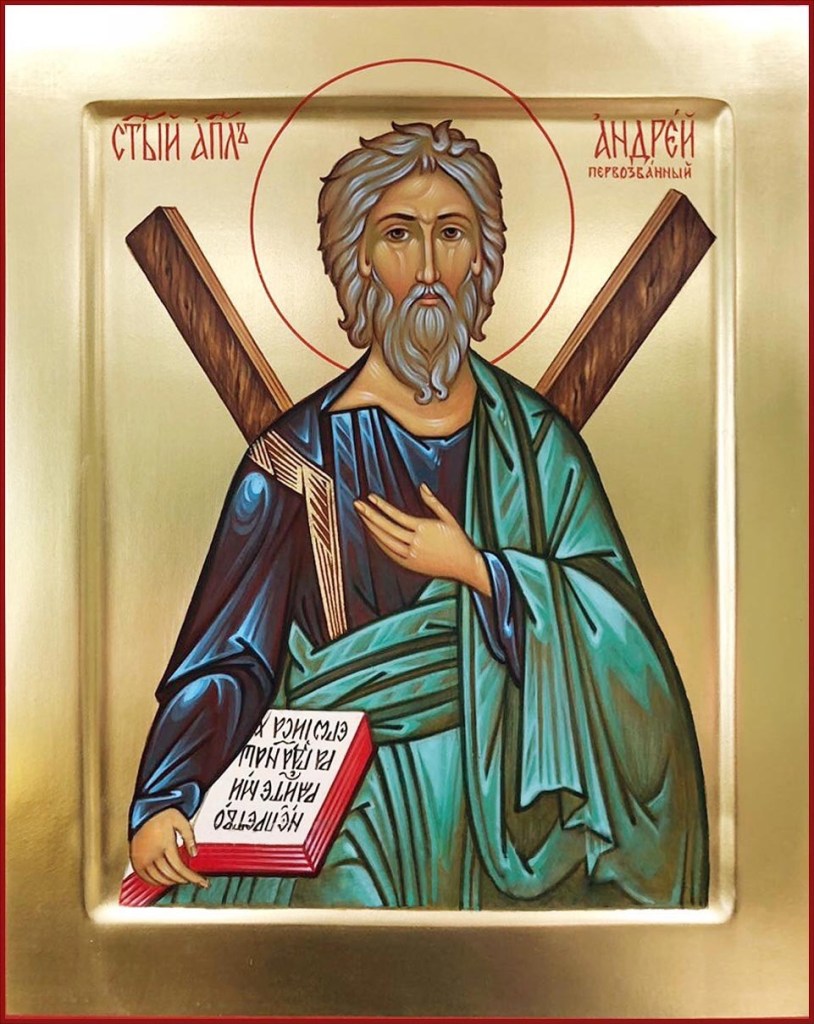
- He requested to be crucified on an X-shaped cross because he felt unworthy to be martyred in the same way as the Lord. He hung on the cross for two days, teaching the people. After beseeching the Lord that he would not be taken down from the cross, he was enveloped in a great light. When it faded away, he gave up his soul.
- The X-shaped cross is also known as: crux decussata, diagonal cross, saltire or St. Andrew’s cross.
- His relics were first taken from Patras to Constantinople in 357. In 1208, the body was taken to Amalfi, Italy (Duomo di Sant’Andrea). In the 15th century, the head was taken to Rome (St. Peter’s Basilica). In 1964, Pope Paul VI returned St. Andrew’s head to Patras (now Pátrai) as a gesture of goodwill toward the separated Christians of Greece.
- According to Eastern Orthodox tradition, the apostolic successor to St. Andrew is the Patriarch of Constantinople.
- St. Andrew is mentioned in the Canon of the Mass along with all the apostles in the Roman Canon, Eucharistic Prayer I.
- He is mentioned in the Tridentine Mass (Traditional Latin Mass) at the Libera Nos and the Fraction of the Host. Therefore, Andrew is the last Saint named before we receive Christ’s Body and Blood.
- The new Daily Roman Missal includes the Prayer of Saint Andrew aka O Bona Crux.
- The Christmas Anticipation Prayer aka St. Andrew Novena is a prayer that’s traditionally recited 15 times a day from his feast day until Christmas Eve. The exact origin is unknown, but it’s believed to have begun in Ireland during the 19th century.
- Patron of: Amalfi, Greece, Romania, Russia, Scotland, Ukraine, butchers, farm workers, fishermen, miners, rope-makers, textile workers, single people
- Pictured: with an X-shaped cross, long white hair and beard, fishing net, holding the Gospel Book or scroll
- Feast Day: November 30
St. Andrew the Apostle, pray for us!
 One Small Rose