January 17th is the feast day of St. Anthony the Abbot.
He’s considered to be one of the most influential saints of all time.
Last year he got my attention in a surprising way, and I felt moved to look into his life and legacy.
In doing so, I discovered that my family has connections to this Saint and his feast day!
I refer to events like this as “Holy Spirit moments” because I don’t believe that anything happens by coincidence.
Connections:
- My paternal great-grandfather was born in Sant’Antonio Abate, Naples, Italy — a town named in honor of Saint Anthony the Abbot
- My maternal grandfather was born on January 17th in San Giuseppe, Naples, Italy — a town named in honor of Saint Joseph
This Saint Spotlight is dedicated to: Anthony the Abbot.
First, I’ll share information about his life.
Then, I’ll share information about his legacy, especially in Italy.
Notes:
- Anthony is the most common English spelling. The name was commonly spelled without the “h” (Antony) before the 17th century
- Anthony is a common name in Italian-American families, including mine. However, it’s typically for St. Anthony of Padua, who is different from the Saint in this post
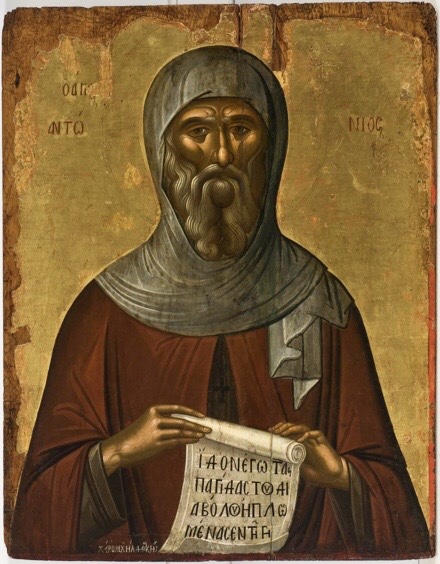
Life
He was born in Egypt in the village of Coma, near the desert of the Thebaid, in the year 251. When St Anthony was about twenty years old, he lost his parents, but he was responsible for the care of his younger sister. Going to church about six months later, he heard the Gospel passage where Christ speaks to the rich young man: If you would be perfect, go, sell what you possess and give it to the poor, and you will have treasure in heaven; and come follow Me (Mt.19:21). Anthony felt that these words applied to him. Therefore, he sold the property that he received after the death of his parents, then distributed the money to the poor, and left his sister in the care of pious virgins in a convent.
Leaving his parental home, St Anthony began his ascetical life in a hut not far from his village. By working with his hands, he was able to earn his livelihood and also alms for the poor. Anthony prayed that the Lord would show him the path of salvation. And he was granted a vision. The ascetic beheld a man, who by turns alternately finished a prayer, and then began to work. This was an angel, which the Lord had sent to instruct His chosen one. St Anthony tried to accustom himself to a stricter way of life. He partook of food only after sunset, he spent all night praying until dawn. Soon he slept only every third day. For even greater solitude, St Anthony moved farther away from the village, into a graveyard.
He asked a friend to bring him a little bread on designated days, then shut himself in a tomb. There he had a vision. Looking up, the saint saw the roof opening, as it were, and a ray of light coming down toward him. The demons disappeared and he cried out, Where have You been, O Merciful Jesus? Why didn’t You appear from the very beginning to end my pain? The Lord replied, I was here, Anthony, but wanted to see your struggle. Now, since you have not yielded, I shall always help you and make your name known throughout all the world.
He was then thirty-five years of age. St Anthony now went into the desert alone. He found an abandoned fort on the other side of the river and settled there, barricading the entrance with stones. His faithful friend brought him bread twice a year, and there was water inside the fort. St Anthony spent twenty years in complete isolation and constant struggle with the demons, and he finally achieved perfect calm. Soon St Anthony’s cell was surrounded by several monasteries, and the saint acted as a father and guide to their inhabitants, giving spiritual instruction to all who came into the desert seeking salvation.
When the Christians were being persecuted and put to death under Maximinus in 312, he hastened to their aid and consolation. When the Church was troubled by the Arians, he went with zeal to Alexandria in 335 and struggled against them in behalf of Orthodoxy. During this time, by the grace of his words, he also turned many unbelievers to Christ. Saint Anthony began his ascetic life outside his village of Coma in Upper Egypt, studying the ways of the ascetics and holy men there, and perfecting himself in the virtues of each until he surpassed them all.
St Anthony spent eighty-five years in the solitary desert. Shortly before his death, he told the brethren that soon he would be taken from them. The saint instructed two of his disciples, who had attended him in the final fifteen years of his life, to bury him in the desert and not in Alexandria. St Anthony died peacefully in the year 356, at age 105, and he was buried in the desert by his disciples.
Saint Athanasius says of him that “his countenance had a great and wonderful grace. This gift also he had from the Saviour. For if he were present in a great company of monks, and any one who did not know him previously wished to see him, immediately coming forward he passed by the rest, and hurried to Anthony, as though attracted by his appearance. Yet neither in height nor breadth was he conspicuous above others, but in the serenity of his manner and the purity of his soul.”
Reference: O.C.A. and G.O.A.A.
Article from: orthodoxmonasteryicons.com
Legacy
Italy
On the 17th of January, Italians celebrate Sant’Antonio Abate, known in English as Saint Anthony of Egypt or Saint Anthony the Great. Anthony is a saint of the early Church and he is considered the first saint hermit, as well as one of the fathers of monasticism. In Italy, he is traditionally considered a santo contadino, that is, a saint connected with rural life and beliefs and that’s why it is said that all animals, on the night of Sant’Antonio Abate, gain the faculty of speaking.
His cult developed first in the East and then reached the West during the early Middle Ages when relics of his arrived in Provence. Later, with the birth of the monastic order of the Antonians, his cult spread across the Alps, to Italy. The Antonians kept alive the idea of the saint as a healer, as they were strictly associated with the care of the ill and working in hospitals. Also the connection of Anthony with animals comes from the work of the Antonians, who used to farm pigs, whose fat was necessary for the making of a balm against shingles (known in Italian also as fuoco di Sant’Antonio – Fire of Saint Anthony). Anthony, so, started being represented with a pig. Soon, other animals became part of the saint’s iconography and so he became the protector of all domestic animals: that’s why he gives them the ability to speak people’s language on the night of his festivity, and why, on the 17th of January, it is customary in Italy to have your pets blessed. Traditionally, the blessing takes place on the square in front of the church, where animals of all kinds and their humans wait for their blessing. While it was certainly more common in the times of our grandparents and great-grandparents, when animals were not solely life companions but also important work helpers, the practice is still widespread across the country, especially in more rural areas, even though big cities – Milan, Parma, and Rome, for instance – do it too.
The cult of Saint Anthony is also associated with fire. Il falò di Sant’Antonio is an ancient tradition that still happens in many parts of the country, always on the 17th of January. Needless to say, the use of fire is, in this case as in many others, associated with ancient pagan rituals where the hottest of the four elements symbolizes life burning and heat chasing away the cold of the winter.
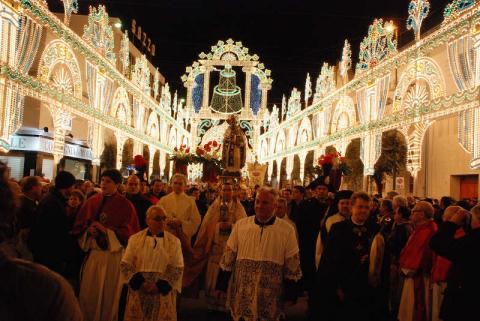
His feast day is celebrated with processions, music, and especially bonfires as one legend claims that he went to hell to steal the devil’s fire, and indeed, while he distracted the devil, his piglet ran in and stole a firebrand to take back to humans on earth.
Article from: italoamericano.org
Universal
Additional Names
St. Anthony
- of the Desert
- of Egypt
- of Thebes
- the Anchorite
- the Great
- the Hermit
Known as the “Father of All Monks”
Patronage
- Against skin diseases
- Animals
- Basket makers
- Brush makers
- Butchers
- Farmers
- Gravediggers
- The poor
Saint Anthony the Abbot, pray for us!
 One Small Rose